
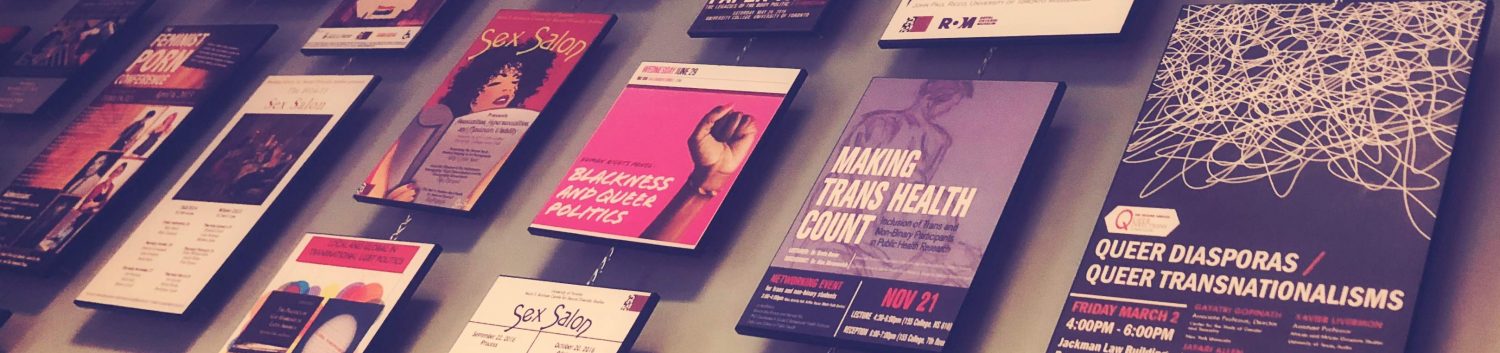
Transgressing Disciplines
a Black trans studies speaker series
convened by Dr. Qui Alexander for the Mark S. Bonham Centre for Sexual Diversity Studies Winter 2026
As Trans studies continues to emerge within a colonial, capitalist and carceral academic landscape, Transgressing Disciplines seeks to offer a collective intervention to interrupt, agitate and transform how we engage with Trans studies. This series invites conversations and collaborations with emerging Black trans thinkers, artists and cultural workers whose crafts transcend traditional modes of inquiry. Inspired by bell hooks’ mandate to transgress—to go beyond a limit or boundary— traditional modes of teaching and learning, this series aims to push scholars to reconsider not just what Trans studies is, but what Trans studies does. In doing so, we disrupt extractive academic norms to create scholarship that nourishes Black trans people and communities. Embracing both interdisciplinary and anti-carceral approaches to Trans studies, Transgressing Disciplines recognizes Black trans life as a site of knowledge production. Together, we work to deepen our collective consciousness of how entanglements of race, class and gender shape our intellectual, artistic and cultural work.
2025-2026
how to do things with big black d*cks: political/theological vignettes of pre-op black trans femininity, fetishism, labor, + performance

In the building of Performance Study, the performative utterance and its wedding to vocality/orality, the words that can do, is the cornerstone. If words can do things, then what other things have the capacity to do and what questions become more important and interesting when we decide not to hide our proclivities, especially what we learn when we’re “doing” it, so to speak? More nearly, the questions we begin with in this experimental performance lecture are: what that mouf do, or, what is a mouf study and what does it have to do with the elementary schism between the arts and the sciences? How are black dicks like words that are (re)arranged and given to (ful)fill and punctuate abundant, syntactic horrors and in what ways do black dicks uncover and recover the erotic (and purloined) thrust of the letters’ availability? How would one describe or write or speak this problematic? And, most importantly, what does thinking through the dissimulation of enfleshment, fantasy, and adornment that is transgenderism’s excitation, often reduced to the terms “trans/femme/woman,” do for us in this matter? Does it even matter?
About the Speaker
@troizel(she/her//princess/babygirl/we) is black + trans + alive and that means more than these words can express.
she studied theater, trans/gender/ism, sexuality, performance, and some thing called blackness at universities called Emory and New York. she received her PhD in Performance Studies at one of them, with a dissertation entitled black performance studies: queer/trans experiments, which brings the study methods of Black queer and trans artists and theorists to bear on Black Studies, Performance Studies, and their historical intermingling called black performance studies. she does this as a way to provide models for how we can perform together to turn out and transform our social assumptions.
formerly: studio resident at Gallery Aferro in Newark, NJ / teaching artist fellow at New Museum of Contemporary Art in New York City / inaugural Museum Institute Scholar at Studio Museum in Harlem / alumna of the Hemispheric Institute for Performance & Politics’ New York Emerging Performers Program (EMERGENYC) / managing editor of Women & Performance: a journal of feminist theory / Visiting Assistant Professor in Visual Studies at Haverford College in Ardmore, PA / co-president of NYU’s Black Alumni Network
For more than 10 years, troizel has worked in the form of theater, performance, creative writing, critical essay, and video to investigate the body, the desires for its re-presentations, and its endurance capacities. Her work unfolds where there is a fault line between what we think and what there is. In their performance and video works, they stage their body as a material question called hottentot pluto, as an embodied confrontation with our social scripts, whether out in public, gallery, or academic spaces.
Presently, troizel is working on three creative projects: the e.g.g.: Eve/(trans)Gender/God(dess), a collection consisting of a one-act play, scholarly essays, poetry and a sermon that mines Biblical narrative, black trans documentation, and performance theories of race, gender, and sexuality; a film work titled swamp of things lost & cunt, an experimental time-lapse using assemblage for stagecraft, puppetry, divination, and performance for video to slow and distill the anti-black/trans violence of the past and present to fast-forward into imagined futures, queering notions of historicity and futurity; and an ongoing zine and book binding series, a colored trans girl’s notes on oblivion, outfitted with a collage of post-it notes, poetry, and polaroids.
otherwise, you can catch her watching reality television, pulling tarot, sucking d*ck, contemplating law and divinity dual degree programs, writing about Eve, Zora Neale Hurston, big black dicks, or trans/sexual/labor, OR teaching at the new school, cooper union, online or in a museum, OR being herself as her sister Rosed Serrano, or in a park with collaborator Isa Hui Saldaña and life sized paper mache eggs or climbing on scaffolding in Pleaser boots with Buffy Sierra or with Experimental School for Black Imagination, an “anti-disciplinary black art school” conceived with comrade and fellow artist Zellá Vanié.
2024-2025
Black Boundlessness: Aesthetics, Performance and Ethics Under Duress
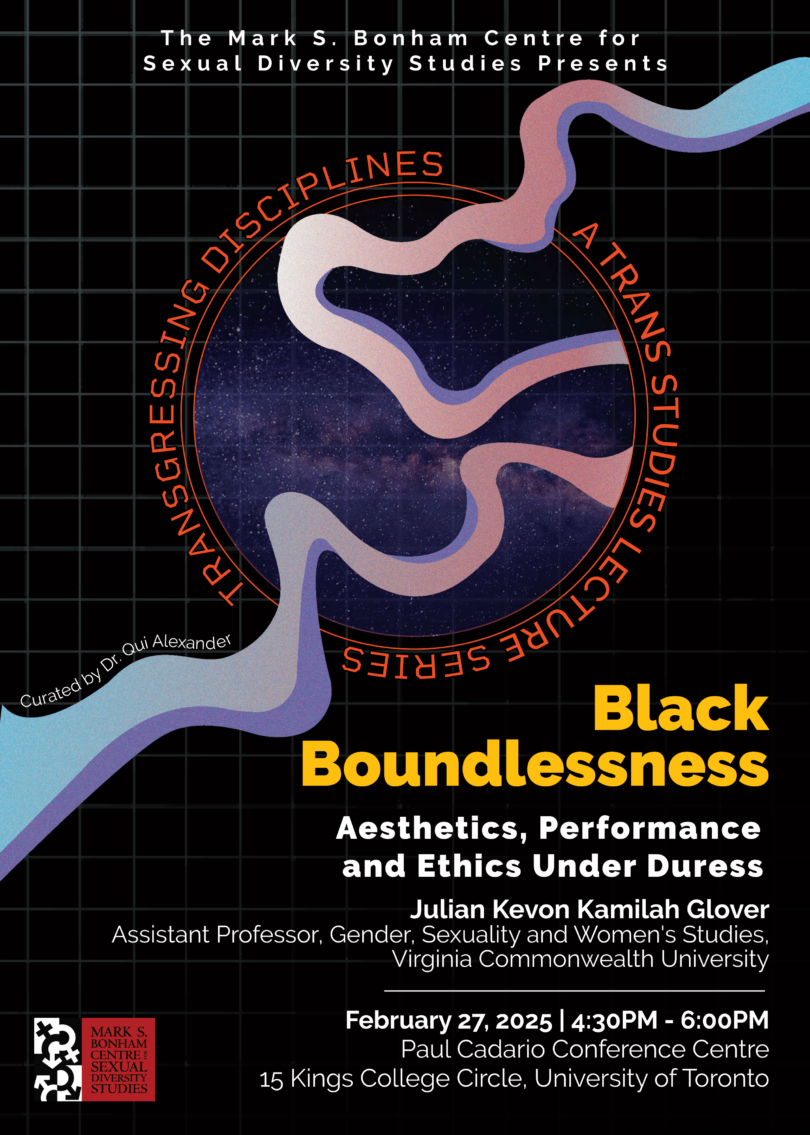
This talk presents an overview of my forthcoming book entitled Black Boundlessness: Aesthetics, Performance and Ethics Under Duress which theorizes that Black life is simultaneously capacious, complex and contradictory precipitating Black artists and everyday people to respond to the myriad manifestations of antiblackness—namely, gratuitous violence, socioeconomic marginalization and spatial exclusion—by establishing freedom practices that enable the cultivation of a meaningful life despite ongoing annihilation. Black Boundlessness investigates freedom practices including multiplicity, transmutation/shapeshifting and critical nonmonogamy to reveal how artists such as such as Moses Sumney and Yves Tumor and writers including Audre Lorde and Taiye Selasi in addition to quotidian Black people engage performance, aesthetics and ethics in visionary ways which hold the potential to propel Black people into a space of boundless possibility.
About the Speaker
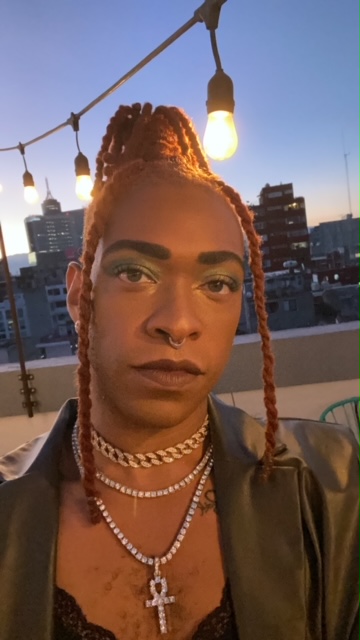
Julian Kevon Kamilah Glover (she/they) is a scholar and artist who graduated with honors from Southern Illinois University Edwardsville, holds an MPA from Indiana University and earned a PhD in Black Studies from Northwestern University. She is currently an Assistant Professor in the Department of Genders, Sexuality and Women’s Studies and the Department of Dance & Choreography at Virginia Commonwealth University where their research focuses on Black/brown queer cultural formations, performance, ethnography, embodied knowledge, performance theory and Black futurity. They were awarded a Franke Fellowship at Northwestern’s Kaplan Institute for the Humanities, a Humanities Research Center fellowship (VCU) and their work appears in journals including American Quarterly, Feminist Formations, South Atlantic Quarterly, Souls, GLQ and Text & Performance Quarterly. Among their numerous awards, she was inducted into the Edward A. Bouchet Graduate Honor Society at Yale University and is a longtime member of the ballroom scene. They have also worked with the Grammy award winning Swedish singer Robyn and appeared in the music video for the title track of her 2018 album Honey. A classically trained cellist, their creative work is multidisciplinary and engages sonic, visual, affective, written and kinesthetic registers with the aim of bringing viewers into critical dialogue with themselves towards psychic, spiritual and interpersonal transformation.
2023-24
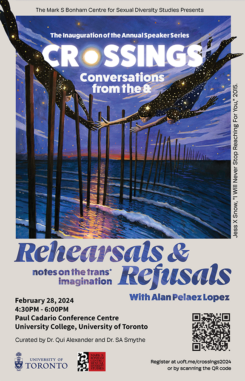
Join us on February 28, 2024 for the talk “Rehearsals & Refusals: notes on trans* imagination” with Alan Pelaez Lopez (@migrantscribble). This is the inaugural lecture in our new speaker series Crossings: Conversations from the &, curated by Dr. Qui Alexander and Dr. SA Smythe. Reserve your ticket at uoft.me/crossings2024.
About The Talk
Gender and sexual diversity are categories mobilized by countries in the Global North to narrate progress, liberal democracy, and unity. However, these same countries force trans* migrants into nonconsensual performance contracts in exchange for conditional protection. Rehearsals & Refusals is a poetic and theoretical address that centers the lived experiences of Black trans* migrants who have been illegalized by Western empires. The talk attends to the way trans* migrants rehearse the performative junctions of race and gender to practice refusal and activate a radical trans*imagination. By weaving Black trans* studies and Indigenous studies, Rehearsals & Refusals proposes kinship and dreaming as methods that negate empire.
About the Speaker
Alan Pelaez Lopez (AfroZapotec) is an artist and scholar from Oaxaca, Mexico invested in the Black Indigenous imagination, trans futurities, abstraction, and opacity.
Image Credit: Jess X Snow (@jessxsnow), “I Will Never Stop Reaching For You,” 2015