
Sexual Representation Archive Accordion
The SRA’s reading room, digitization stations, and processing workspaces are located on the lower level of University College, 15 King’s College Circle, Rooms 41 and 43. Inquiries may be directed to the Lead Curator, John Paul Ricco, at john.ricco@utoronto.ca, and the Project Manager, Madeleine Vien, at madeleine.vien@mail.utoronto.ca The SRA is accessible for visitors using wheelchairs or other mobility devices; additional arrangements can be made on an individual basis.
Researchers are welcome to visit the collection by appointment. Please contact the Project Manager Madeleine Vien at madeleine.vien@mail.utoronto.ca to schedule a suitable time weekdays between 9am – 5pm. The Project Manager is happy to assist with any reference questions and to provide additional resources related to your research. Unfortunately, the SRA does not employ any full-time staff and is therefore limited in the kinds of remote assistance it can provide.
The SRA is a non-circulating archive. Material held by the SRA is open to the public; some archives, including digital copies, may have restrictions based on individuals’ privacy, donor specific restrictions, and the condition of the material. Before visiting the SRA, please consult our list of finding aids below. The Brian Pronger Reading Room contains a shared desktop computer with internet access, a scanner/ printer, and a television with VHS and DVD players. Digitization services, including digital research copies, are available upon request. Researchers are strongly encouraged to bring their own laptops.
We ask researchers to request permission to publish, exhibit or use records and to determine the appropriate acknowledgement(s), particularly to ensure personal or confidential information is not released. Failure to acquire permissions or to provide adequate acknowledgement is a violation of copyright law. Please credit “The Sexual Representation Archive, Bonham Centre for Sexual Diversity Studies, University of Toronto.”
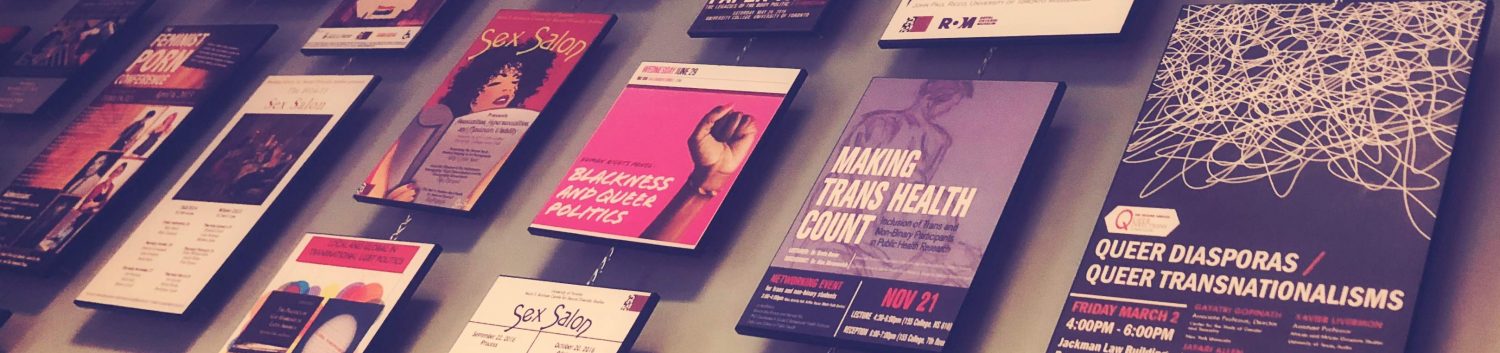
SRA regularly organizes talks, panels, and workshops that provide a public forum for engaging social, cultural, and legal issues related to the sex industries, sex work, and pornography. These events bring together established and emerging scholars, people who have worked in the sex industry or are sex workers, and members of the community to develop a conversation that extends beyond the archive. In addition, SRA regularly partners with cultural institutions and university courses to exhibit highlights from the collection for a broader public. These exhibits rethink the politics and performance of public display and expand traditional ways of telling stories about archival objects. Support for these events comes from the Bonham Centre for Sexual Diversity Studies and community partners. Please consult the Events page on the Centre’s website for details about upcoming events and exhibits. While you're there, check out our Sexual Representation Archive Annual Speaker Series too!
The SRA actively accepts archival donations relating to adult entertainment, sex work, and education, including its social and legal regulation, production, circulation, and consumption. We prioritize feminist, queer, trans, and kink material. Please contact the Lead Curator by email at john.ricco@utoronto.ca with possible donations. Materials will be assessed according to our mandate, the significance of the materials, and space limitations for long-term storage and preservation.
Digitization for scholarly or preservation purposes falls under the terms of the "Libraries, Archives, and Museums" exceptions in section 30.1 of Canada's Copyright Act. Unlike the United States, Canada lacks an orphan works regime. When determining whether to disseminate third-party copyrighted material without restrictions, we rely on Simon Fraser University's "Risk Management Copyright Policy Framework for SFU Library Digitization Projects" (2016), the standard copyright guideline for library and archival digitization projects in Canada. Beyond copyright law, in cases where materials are not part of the public domain, we have an ethical obligation to obtain creator and performer consent, if possible, before making materials openly accessible online. This is critical for maintaining trust and faith with members of the sex industries and for honouring sex work as work. In cases where we are unable to determine copyright and where we are unable to obtain creator and performer consent, we make materials accessible through SharePoint, a University-administered storage platform with a secure firewall.